
How to Get Cited by ChatGPT, Perplexity & Google AI Overviews
GEO Academy · Module 2 — The Goal · Updated August 2026 · by Octoplug
You get cited by AI when a generative engine trusts your page enough to pull it into an answer and name you as the source. That happens when your content is easy for the model to find, parse and quote: clear answer-first writing, structured data that tells the engine who you are, AI crawlers allowed in, and a site it reads as fresh and credible. No file or plugin can force a citation — but you can stack the signals that make one far more likely.
On this page11 sections
This guide is about that stack. It covers what “getting cited” actually means, why your site might be invisible in AI answers right now, how ChatGPT, Perplexity and Google AI Overviews decide what to surface, and how to structure your content so an engine can quote it. It ends with the honest part: how to tell whether any of it is working.
- How to track your AI citations (free and paid ways) — coming soon
- Why isn’t my site showing up in ChatGPT answers? (7 reasons) — coming soon
- Answer-first writing: how to structure content AI will quote — coming soon
- Schema Markup for AI: JSON-LD That Helps LLMs Understand Your Site — coming soon
- llms.txt for WordPress: The Complete Guide — coming soon
- AI Overviews: what Google’s 2026 AI guidance really changed — coming soon
What does “getting cited by AI” actually mean?
It means a generative engine uses your content in its answer and attributes it to you — a linked source under a ChatGPT reply, a citation card in Perplexity, a listed link in a Google AI Overview. It’s the AI-search equivalent of a first-page ranking, but the mechanics differ: instead of ten blue links, the engine synthesises one answer and names a handful of sources. You want to be one of them.
The distinction that matters: being cited is not the same as being mentioned. An engine can mention your brand from memory without linking you, and it can cite a page without naming your brand in the prose. Both have value, but they’re different signals — and, as we’ll see, they’re worth measuring separately rather than lumping together.
Why isn’t my site showing up in ChatGPT answers?
Usually for one of a few fixable reasons: AI crawlers can’t reach your content, your pages aren’t structured in a way a model can extract, your site doesn’t clearly signal who you are, or your content simply isn’t the best answer to that question. Sometimes it’s none of those — the engine just hasn’t indexed you yet, or doesn’t cite live sources for that query at all.
Before assuming the worst, rule out the boring causes. Is GPTBot or PerplexityBot blocked in your robots.txt? Is your best content buried under vague headings a model can’t map to a question? Is there any structured data telling the engine your organisation exists? Invisibility in AI answers is rarely one big problem — it’s usually three or four small ones stacked.
How do AI engines decide what to cite?
They weigh a blend of signals: how relevant your page is to the question, how cleanly the answer can be extracted, how authoritative and fresh the source looks, and whether the engine is even allowed to read it. No engine publishes its exact formula, and each weighs things differently — but the inputs rhyme with classic search quality, plus a heavy premium on extractability: content a model can lift a clean, self-contained answer from.
That last point is the lever most sites ignore. Google’s ranking has always rewarded good content; generative engines add a second bar — the answer has to be quotable. A brilliant 2,000-word essay with no clear, atomic answer to the question is harder to cite than a tight 60-word paragraph that nails it. Structure, not just substance, decides whether you make the cut.
How do I structure content so AI will quote it?
Write answer-first: put a direct, self-contained answer to the question in the first 40–80 words after each heading, then expand. Use real questions as your headings — the ones people actually type or say. Keep answers atomic, so a model can lift one paragraph and have it stand on its own. This is the single highest-leverage habit for getting quoted, and it costs nothing but discipline.
Notice that this very article is built that way — every H2 is a question, every answer that follows is a standalone block. That’s not a coincidence: it’s the format generative engines find easiest to extract. Beyond structure, favour clear language over cleverness, break content into scannable sections, add a genuine FAQ, and make one page the definitive answer to one question rather than ten pages half-answering it.
Does schema markup help me get cited?
Yes — structured data helps AI understand what your content is and who published it, which reduces the guesswork between your page and a citation. JSON-LD schema (Organization, WebSite, Article, Breadcrumb, FAQPage) turns implicit context into explicit, machine-readable facts. It won’t write your answer for you, but it removes ambiguity — and ambiguity is what makes an engine skip a source it can’t confidently attribute.
Two kinds of schema pull real weight for AI search. FAQPage markup pairs perfectly with answer-first writing: it hands the engine clean question-and-answer pairs it can quote directly. Entity schema — an Organization block, and a Person block with sameAs links to your verified profiles — helps engines connect your content to a known, trusted identity rather than an anonymous page.
Can AI crawlers even reach my content?
If AI crawlers are blocked, nothing else matters — you can’t be cited from a page the engine was never allowed to read. Many sites accidentally block GPTBot, PerplexityBot, Google-Extended and others in robots.txt, or sit behind aggressive bot-protection that turns them away. Step one of any AI-visibility audit is confirming the engines you want citing you are actually permitted in.
This cuts both ways, and it’s a real decision, not a default. You may want some AI crawlers in and others out — allowing the engines you care about while blocking training-only bots you don’t. The point is to choose deliberately, per crawler, and then keep that choice consistent with the rest of your GEO stack. An llms.txt that maps your best content is useless if the crawler that would read it is turned away at the door.

GEO Suite (free — direct download) checks whether AI crawlers can read you, builds your schema, and scores where you stand — alongside your existing SEO plugin.
How do I get cited in Google AI Overviews?
AI Overviews pull from Google’s existing index, so classic SEO fundamentals still apply — but the content that gets surfaced tends to be clear, well-structured, answer-first material that maps neatly to the query. Being indexed and ranking well remains the entry ticket; being quotable is what gets you into the Overview itself rather than just the links below it.
Google has been increasingly explicit that there’s no separate “AI Overviews ranking system” to game — the same quality, helpfulness and structure signals feed both. In practice that means the work you do for ChatGPT and Perplexity — answer-first structure, FAQ schema, clear entity signals, fresh and trustworthy content — is largely the same work that improves your odds in AI Overviews. One discipline, three surfaces.
Do ChatGPT, Perplexity and Gemini cite differently?
Yes. They draw on different sources, cite with different frequency, and update on different schedules — so a page cited by Perplexity today may be absent from ChatGPT and vice versa. Perplexity leans heavily on live, linked sources; ChatGPT cites when browsing is active and its sources allow it; Gemini blends its index with Google’s signals. Assume no single result generalises across all of them.
The practical takeaway: don’t optimise for one engine. The signals that travel well across all of them — clean structure, clear identity, fresh content, crawler access — are the ones worth investing in, because they compound across every surface at once. Chasing the quirks of a single engine is a losing game; building broadly quotable content wins on all three.
How do I know if I’m actually being cited?
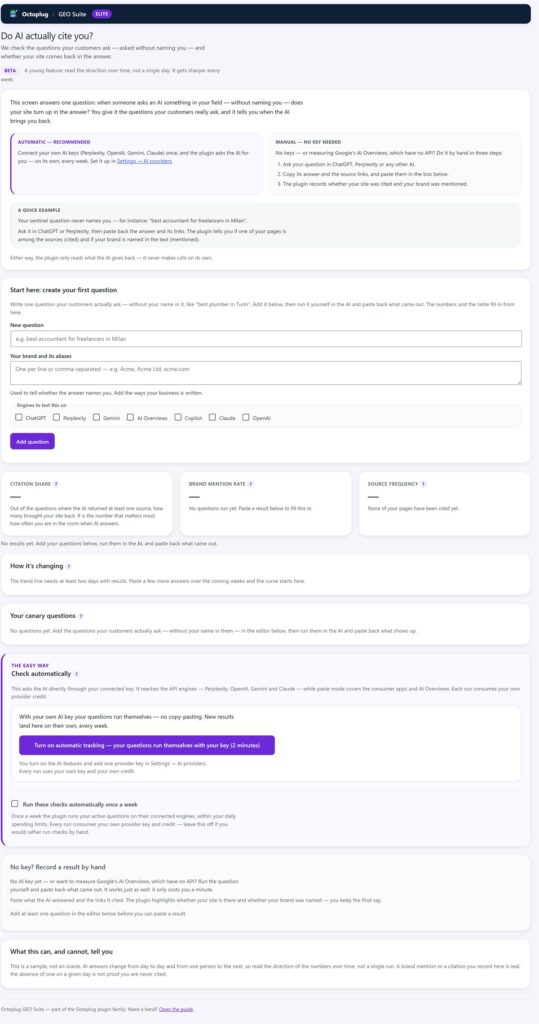
You check — and this is where most sites go dark, because they do the GEO work but never measure the outcome. You can spot-check by hand: ask each engine the questions your customers ask and see whether you appear. That’s free but slow, unsystematic, and impossible to track over time. To answer “am I in AI answers, and is it improving?” with real numbers, you need to monitor it deliberately.
There are two honest routes. Enterprise GEO SaaS platforms (Peec, Otterly, Scrunch, Profound and others) monitor hundreds of prompts across engines — powerful, and priced like it, often $89–499/month. Or you measure from inside WordPress with a plugin. That’s the gap GEO Suite Pro fills: its AI citation tracker lets you check whether your content shows up in AI answers, automatically using your own API keys — plus a manual-paste mode (Beta) for surfaces like AI Overviews that don’t expose an API.
It reports the metrics that matter — how often you’re cited, how often you’re mentioned, how frequently you’re used as a source — and tracks them over time, so you can see whether the changes you make actually move the needle. It won’t promise you citations, and no honest tool would: it tells you the truth about where you stand.
Can any tool guarantee I’ll be cited by AI?
No — and be sceptical of anyone who says otherwise. Generative engines make their own opaque decisions, weighing signals no third party controls. What a good tool and a good method do is stack the odds: make your content easy to find, parse, trust and quote, and then measure whether it’s working so you can keep improving. That’s the honest ceiling — real, useful, and worth pursuing — but it’s not a switch anyone can flip for you.
Treat “guaranteed AI citations” the way you’d treat “guaranteed #1 on Google”: a red flag. The sites that actually get cited aren’t the ones that bought a promise — they’re the ones that did the unglamorous work of clear structure, clean data and crawler access, then watched the numbers and adjusted. Method plus measurement beats magic, every time.
Frequently asked questions
How do I get cited by ChatGPT?
Make your content easy for it to find, parse and quote: write answer-first with real-question headings, add structured data (Organization, Article, FAQPage), allow GPTBot in your robots.txt, and keep your content fresh. No method guarantees a citation, but stacking these signals meaningfully improves your odds.
Why isn't my website showing up in AI answers?
Usually because AI crawlers are blocked, your content isn't structured for extraction, your site doesn't clearly signal its identity, or a stronger source answers the question better. It can also be that the engine simply hasn't indexed you yet. Most cases are several small, fixable issues stacked together.
How can I check if I'm being cited by AI?
Manually, by asking each engine the questions your audience asks and looking for your site. To track it systematically over time you need monitoring — either an enterprise GEO SaaS platform (typically $89–499/month) or a WordPress plugin like GEO Suite Pro, which checks your AI visibility from inside your own site.
Is getting cited by AI the same as ranking on Google?
Related but not identical. Classic SEO gets you indexed and ranked; AI citation adds a second bar — your answer has to be quotable, self-contained and easy to extract. Good SEO helps, but answer-first structure and clean schema are what push you from "ranked" to "cited".
Does schema markup get me cited by AI?
It helps. Structured data tells engines what your content is and who published it, reducing the ambiguity that makes them skip a source. FAQPage schema gives them ready-to-quote Q&A; entity schema (Organization, Person with sameAs) ties your content to a trusted identity. It's a strong supporting signal, not a standalone guarantee.
Can I get into Google AI Overviews specifically?
There's no separate ranking system to game — AI Overviews draw on Google's existing index and the same quality signals as classic results. Rank well, structure content answer-first, add FAQ schema and keep it fresh. The work that helps you in ChatGPT and Perplexity largely helps you in AI Overviews too.
Free plugin
See where your site stands with AI search — free
GEO Suite scores your site across the six GEO pillars, generates your llms.txt and JSON-LD schema, and shows you what to fix first.
Score your site across the six GEO pillars, generate your llms.txt and JSON-LD, and see what to fix first.
Download free →