
Answer Engine Optimization (AEO): The Practical Guide for WordPress
GEO Academy · Module 6 — Answer Engines · Updated August 2026 · by Octoplug
Answer Engine Optimization (AEO) is the practice of structuring your content so answer engines — AI assistants, voice search and featured snippets — can lift a clear, direct answer straight from your page. Instead of competing for a click, you compete to be the answer. On WordPress that means writing in a question-and-answer shape, adding the right structured data, and making sure machines can read and trust your pages.
On this page10 sections
Below: what AEO actually means, how it relates to GEO and SEO (they are not the same, and the difference matters), the on-page patterns that get you into answers, the schema that helps, and a concrete order of work you can run on WordPress this week.
- AEO vs GEO: are they the same thing? — coming soon
- FAQ schema and AEO: how structured Q&A gets you into answers — coming soon
- Speakable content and voice/answer engines: what to mark up — coming soon
- AEO checklist for WordPress: 12 things to fix this week — coming soon
What is Answer Engine Optimization (AEO)?
AEO is optimizing your content to be selected as the direct answer to a question, rather than one of ten blue links to click. Answer engines — Google’s featured snippets and AI Overviews, voice assistants like Alexa and Siri, and AI chat tools — don’t return a list; they return one response. AEO is the work of making your page the source that response is built from: clear questions, concise answers, and structure a machine can parse without guessing.
The shift is behavioural. People increasingly ask a full question and expect a single, spoken or summarised answer — no scrolling, no tabs. “What’s the best time to prune roses?” returns an answer, not a search results page. AEO is how you make sure the answer is yours, attributed to your site, instead of a competitor’s.
How is AEO different from GEO and SEO?
SEO gets you ranked, GEO gets you cited by generative AI, and AEO gets you picked as the direct answer — they overlap, but they optimise for different outcomes. The cleanest way to hold it in your head: SEO is the foundation, GEO is the umbrella, and AEO is the answer-engine slice under it. You don’t choose one; you build SEO first, then layer AEO and GEO on top.
| Discipline | Optimises for | Typical surface | Winning unit |
|---|---|---|---|
| SEO | Ranking in classic search | Google’s blue links | The ranked page |
| AEO | Being the direct answer | Featured snippets, voice, answer boxes | The extracted answer |
| GEO | Being found & cited by generative AI | ChatGPT, Perplexity, Gemini, AI Overviews | The citation |
In day-to-day use the terms blur, and plenty of people say “AEO” and “GEO” interchangeably. That’s fine. What matters is the work, and the work overlaps almost entirely: structure content clearly, mark it up, and make it machine-readable.
Does AEO replace SEO?
No. AEO is built on top of SEO, not instead of it. Answer engines pull from content that is already discoverable, well-structured and credible — and those are SEO fundamentals. If your pages aren’t indexable, fast and relevant, there’s nothing for an answer engine to extract in the first place. Think of SEO as earning the right to be in the running, and AEO as winning the specific answer.
So keep your SEO plugin and your on-page basics: titles, meta descriptions, internal links, clean URLs, page speed. AEO adds a layer — answer-first structure and richer structured data — aimed at a newer set of readers (assistants and AI models) that consume your content differently. The two are complementary, and the sites that win answers almost always have solid SEO underneath.
How do answer engines choose which content to use?
They favour content that answers a clear question quickly, unambiguously, and in a structure they can extract. An answer engine is looking for a self-contained passage it can lift with confidence: a direct response near a matching question, backed by structure (headings, lists, schema) that confirms this text answers that question. Vague, buried or padded answers get skipped in favour of a competitor who made the extraction easy.
A few signals consistently help:
- Proximity and match — the answer sits right under a heading that mirrors the question a user actually asks.
- Concision — a tight 40–60 word answer is easier to lift than three rambling paragraphs.
- Structure — lists, tables and steps map cleanly onto how answers are displayed and spoken.
- Corroboration — structured data tells the machine explicitly what the content is, reducing guesswork.
- Trust — freshness, author identity and consistency across the web all raise confidence.
None of this guarantees you’ll be chosen — engines weigh many signals and change often — but it stacks the odds. That’s the honest ceiling of AEO: you make your content the easiest, most reliable answer to extract, and let the engine do the rest.
How do you write answer-first content?
Answer-first content leads with the answer, then explains — the inverse of a slow-building blog post. For every question your audience asks, create a heading phrased as that exact question, then give a complete, standalone answer in the first 40–60 words underneath. A reader (or an assistant) should get the full answer from that opening passage alone, before any elaboration. Everything after is depth for those who want it.
The pattern, applied to a WordPress post:
- Use real questions as H2 headings. Not “Pruning tips” but “When should you prune roses?” — the way someone would ask an assistant.
- Answer immediately, in one self-contained passage. No windup. If the passage were pulled out on its own, it would still make sense.
- Keep the answer tight, then expand below with detail, examples and nuance.
- Use lists and tables for steps, comparisons and options — they extract and read aloud cleanly.
- Add an FAQ section at the end for the long-tail questions that don’t warrant a full heading.
This entire article is written that way on purpose: every H2 is a question, every answer stands on its own. We practise it because it’s what answer engines reward. If you’d rather not restructure everything by hand, tooling can help draft answer-first blocks and FAQs for you — but the method matters more than the tool.

GEO Suite (free — direct download) scores your site across six pillars and generates the core schema answer engines lean on — including FAQPage — so you can see exactly what stands between your content and the answer box.
What schema markup helps with AEO?
FAQPage, HowTo, Article and Speakable schema are the structured-data types that most directly help answer engines understand and extract your content. Schema is JSON-LD you add to a page to state, in machine-readable form, “this is a question and this is its answer,” or “these are the steps.” It removes ambiguity — instead of inferring that a passage is a Q&A, the engine is told, which makes your content far easier to select as an answer.
- FAQPage — marks up a list of questions and answers. The single highest-leverage schema for AEO, because it maps exactly onto how answer engines think.
- HowTo — marks up step-by-step instructions, ideal for procedural and voice queries.
- Article — establishes what the page is, who wrote it and when, feeding trust and freshness signals.
- Speakable — flags the specific passages best suited to be read aloud by voice assistants.
On WordPress you can hand-code this, but keeping it valid and in sync with your content across a whole site is where it breaks down manually. A plugin that generates and maintains schema — running alongside your SEO plugin, not against it — is the sustainable route.
What is Speakable content and does voice search matter?
Speakable content is text you explicitly mark up as suitable for voice assistants to read aloud, and it matters as more people ask questions by voice. The Speakable property flags the sentences that best answer a query in spoken form — typically a crisp summary near the top of the page. Voice answers are, by nature, single answers: there’s no page of results to read out, which makes voice one of the purest AEO surfaces.
Voice and answer engines reward the same discipline: short, direct, well-structured answers. If your content already leads with a tight response under a question-shaped heading, you’re most of the way there — Speakable markup just makes the best passage explicit. It’s a forward-looking signal rather than a finished, universally-supported standard, so treat it as sensible preparation, not a magic switch.
How do you do AEO on WordPress, step by step?
On WordPress, AEO comes down to five moves: write answer-first, add FAQ and Article schema, mark up voice-ready passages, keep content fresh, and make sure AI can crawl it. None of these require code if you use the right tooling, and together they turn an ordinary WordPress post into content an answer engine can confidently extract from.
- Restructure your key posts answer-first — question headings, standalone answers, lists where they fit.
- Add an FAQ block to cornerstone pages and mark it up with FAQPage schema.
- Ensure Article schema is present so machines know the what/who/when.
- Mark voice-ready passages with Speakable on your most-asked pages.
- Keep it current and crawlable — refresh stale answers, and confirm the AI crawlers you want (GPTBot, PerplexityBot, Google-Extended) are allowed in.
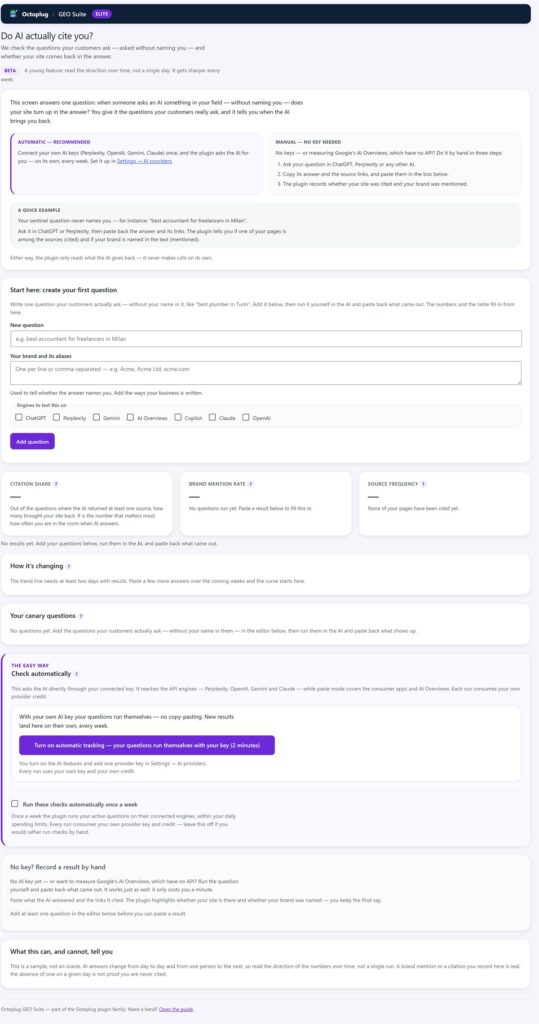
This is exactly the ground GEO Suite covers. The free plugin scores your readiness across six pillars — including how readable and structured your content is for AI — and generates the core schema (Organization, WebSite, Article, Breadcrumb and FAQPage) that AEO leans on, alongside your existing SEO plugin, with control over which AI crawlers reach your site.
The deeper AEO work builds from there: speakable and advanced structured data live in the Pro tier (from €99/year) along with per-page analysis and AI-citation tracking; and if you’d rather have answer-first rewrites, FAQs and schema generated for you, that’s what the Elite tier (from €149/year) automates, with preview and undo. Free is the honest place to start: it tells you where you stand before you spend a thing.
Does AEO guarantee you’ll win the answer box?
No — and treat any tool that promises it with suspicion. No plugin, agency or SaaS can guarantee an answer engine will pick your content. Featured snippets, AI Overviews and voice answers are chosen by systems weighing dozens of signals you don’t control, and they change constantly. What AEO does is make your content the clearest, best-structured, most extractable candidate — which measurably improves your odds. That’s the real, honest promise: better preparation, better chances, no certainties.
The upside is that the work is worth doing regardless. Answer-first structure and clean schema make your content better for human readers too, feed your classic SEO, and prepare you for whatever answer surfaces come next. You’re not betting on one engine’s algorithm — you’re building content that’s easier to understand, quote and trust across all of them.
Frequently asked questions
Is AEO the same as SEO?
No. SEO optimises for ranking in classic search results; AEO optimises for being selected as the direct answer in featured snippets, voice search and AI answer boxes. AEO builds on top of SEO — you need solid SEO fundamentals first, then layer answer-first structure and schema on top. They're complementary, not competing.
Is AEO the same as GEO?
They overlap heavily and are often used interchangeably. The useful distinction: GEO (Generative Engine Optimization) is the broad umbrella for being found and cited by generative AI; AEO is the focused, answer-first discipline aimed at winning the single-answer moment (snippets, voice, answer boxes). Do the work and you cover both — the techniques are nearly identical.
What is the most important thing for AEO?
Answer-first structure. Lead every key section with a question-shaped heading and a complete, standalone answer in the first 40–60 words. That single habit does more than any tool, because it gives answer engines a clean passage to extract. Add FAQPage schema on top and you've covered the essentials.
Do I need schema for AEO?
It's strongly recommended, not strictly required. Answer engines can extract from well-structured plain content, but schema (especially FAQPage) removes ambiguity by telling machines exactly what your content is. It reliably improves your odds of being selected. On WordPress a plugin can generate and maintain it so it stays valid and in sync with your content.
Can I do AEO with my existing SEO plugin?
Partly. Yoast, RankMath and AIOSEO handle classic SEO and some schema, but they're not built around AI answer extraction or citation tracking. AEO tooling is designed to run alongside them, adding answer-first scoring, AI-specific schema and crawler control — not to replace them.
Will AEO get me into ChatGPT or voice answers?
It improves your chances by making your content the clearest, most extractable answer, but no one can guarantee selection. Answer and generative engines weigh many signals and change frequently. Pair answer-first content, schema and freshness for the best odds — and measure whether it's working rather than assuming.
Free plugin
See where your site stands with AI search — free
GEO Suite scores your site across the six GEO pillars, generates your llms.txt and JSON-LD schema, and shows you what to fix first.
Score your site across the six GEO pillars, generate your llms.txt and JSON-LD, and see what to fix first.
Download free →