
Schema Markup for AI: JSON-LD That Helps LLMs Understand Your Site
GEO Academy · Module 5 — Structured Data · Updated August 2026 · by Octoplug
Schema markup is structured data — usually written in JSON-LD — that describes your content in a machine-readable format, so search engines and AI models understand not just the words on a page, but what they mean. It turns “this page mentions a company, a price and an author” into explicit facts: this is the Organization, this is the Article, this is the person who wrote it. For AI search, that clarity is the difference between being understood correctly and being guessed at.
On this page12 sections
This is where GEO gets technical. We go under the hood: which schema types actually help large language models, how they map your content to real-world entities, why entity identity via sameAs is the layer most sites skip, and exactly how to add the right JSON-LD to WordPress — by hand or automatically.
What is schema markup, and what is JSON-LD?
Schema markup is a shared vocabulary (from Schema.org) for describing things on the web — organizations, articles, people, products, FAQs — in a way machines can parse. JSON-LD is the recommended format for writing it: a small block of structured JSON, added to your page, that labels your content without changing how it looks. Same information, but explicit instead of implied.
A human reads “Acme Analytics — privacy-first web analytics, founded 2021” and instantly understands it’s a company; a machine sees a string of text. Schema removes the ambiguity: it says, in a format built for machines, this is an Organization, its name is Acme Analytics, its logo is here, its social profiles are there. JSON-LD is just the cleanest way to write that down — a block in your page’s <head> that visitors never see but machines always read.
Why does schema matter for AI search, not just Google?
Because generative engines have the same core problem Google’s crawler does — understanding what your content actually means — and schema solves it faster. When ChatGPT, Perplexity or Google’s AI Overviews assemble an answer, they need to identify entities, attribute facts to sources, and decide what to trust. Explicit structured data reduces the interpretation they have to do, which lowers the chance your content is misread, misattributed, or skipped.
Classic SEO has used schema for years to earn rich results — star ratings, FAQ dropdowns, breadcrumbs in the listing. GEO uses the same markup for a newer purpose: helping language models build an accurate picture of who you are and what you know. A model that can cleanly parse “this article was written by this person, an identifiable expert, on behalf of this organization” has more reason to treat your content as a citable source. Schema doesn’t force a citation — nothing does — but it removes friction, and friction is what keeps well-written pages out of AI answers.
Which schema types matter most for LLMs?
A handful do most of the work: Organization and WebSite (who you are), Article (what a page is and who wrote it), BreadcrumbList (how your content is organised), FAQPage (structured questions and answers), and Person with sameAs (proving the identity of an author or brand across the web). You don’t need dozens of types — you need the few that establish identity, authorship and structure clearly.
| Schema type | What it tells AI | Why it matters for GEO |
|---|---|---|
| Organization | Who publishes this site — name, logo, profiles | Establishes the entity behind the content |
| WebSite | The site as a whole, its name and search behaviour | Anchors your domain as a recognisable source |
| Article | This page is an article, by this author, on this date | Attributes content and signals freshness |
| BreadcrumbList | Where this page sits in your structure | Helps AI understand topical hierarchy |
| FAQPage | These are questions and their answers | Maps directly to how people query AI |
Person + sameAs |
This author is this identifiable person | Proves entity identity — the advanced layer |
The first five are foundational: every serious content site should have them. The sixth — Person with sameAs — is the advanced move that ties an author or brand to a verifiable identity across the web. It’s the layer most sites skip, and the one that does the most for entity recognition.
Organization vs WebSite vs Article: which one, when?
Organization and WebSite describe your site as a whole and belong sitewide; Article describes a single piece of content and belongs on each post or page that is one. They’re not alternatives — they stack: Organization says who publishes, WebSite anchors the domain, and Article marks up each individual page underneath. Getting the layering right matters more than adding exotic types.
In practice: Organization carries your name, logo and official profiles, added once sitewide. WebSite represents the domain itself and confirms its canonical name. Article goes on each post — headline, author, publish and modified dates, linked back to the Organization — which is what lets an AI say “according to an article by X on Y…” with confidence. BreadcrumbList sits alongside Article, showing where the page lives in your hierarchy.
The mistake most sites make isn’t choosing the wrong type — it’s applying types inconsistently: Organization on some pages but not others, Article missing its author, dates that don’t match the visible content. Consistency is the whole game. Structured data that contradicts your page, or appears on some templates and not others, is worse than none, because it teaches machines to distrust your markup.
What is entity identity, and how does sameAs prove who you are?
An “entity” is a distinct, identifiable thing — a specific company, a specific person — that AI systems track across the whole web. sameAs is the schema property that connects your on-site identity to authoritative external references (your LinkedIn, Wikipedia, Crunchbase, verified social profiles), effectively saying: “the person named here is the same person you already know about over there.” That link is how a model resolves ambiguity and decides you’re a real, trustworthy source rather than one of a hundred people with your name.
This matters more for AI than for classic search. When you ask a language model “who is the best source on privacy-first analytics?”, it’s reasoning about entities and their authority. If your author is just a name in a byline, you’re an unknown; if your author is a Person entity with sameAs links to established profiles, you’re a resolvable identity the model can attach reputation to. This is the layer that separates “a website that published something” from “a recognised source” — and it’s exactly why the biggest gap on most sites is entity identity, not basic markup.
How does FAQPage schema get you into AI answers?
FAQPage schema marks up genuine questions and their answers in a format that maps almost perfectly onto how people query AI — because someone asking ChatGPT a question is asking a question. Well-structured Q&A content, labelled with FAQPage schema, is some of the most directly quotable material you can publish. The rule is simple: the questions and answers must actually appear on the page and be visible to users.
Google tightened its stance here, and the same discipline protects you across engines. Do mark up only FAQs genuinely present and visible; keep questions and answers matching the on-page text word-for-word; use FAQPage for real informational Q&A. Don’t add schema for content users can’t see, duplicate the same block across dozens of pages, or use it to game rich results — the cost of getting caught is losing trust in all your markup. Done honestly, an FAQ section captures long-tail questions on Google and hands AI pre-structured, quotable answers.
Do you still need schema if you already use Yoast or RankMath?
Yoast and RankMath add solid baseline schema — typically Organization, WebSite, Article and Breadcrumb — so you’re not starting from zero. But they’re built for classic SEO rich results, not for the AI-specific layer: entity identity via sameAs, speakable content, and a readiness view that tells you what’s missing for generative engines. A GEO tool complements your SEO plugin; it doesn’t replace it.
Be clear-eyed about this. If you run Yoast or RankMath you already have the foundations covered — keep them. Where a GEO-focused tool adds value is the parts SEO plugins weren’t designed for: measuring your site against AI-readiness signals specifically, generating the advanced entity markup that helps LLMs resolve who you are, and scoring the whole picture so you can see the gaps. The goal is a clean, non-conflicting stack, not a turf war over your <head>. If your SEO plugin’s schema is doing its job, the answer isn’t “rip it out,” it’s “add the AI layer it doesn’t cover.”
How do you add AI-ready schema to WordPress?
Two routes: write the JSON-LD by hand and inject it into your pages, or let a plugin generate it from your existing content automatically. Manual gives total control but has to be maintained by hand every time content changes; a plugin builds valid, consistent schema from what’s already on your site and keeps it current. For most sites the plugin route wins on consistency alone — and consistency, as we’ve seen, is what makes schema trustworthy.
Option 1 — Add schema manually
Write a JSON-LD block for each type you need, following Schema.org’s vocabulary, and inject it into the page <head> via a code snippet, a functions.php hook, or a header-injection plugin. The catch is maintenance and consistency: you’ll need a block per template, dates that update when you edit, authors that stay accurate, and identical structure across every page. Do it by hand across a real site and drift is inevitable — a missing author here, a stale date there — and drift is exactly what erodes the trust your markup is supposed to build.
Option 2 — Generate schema with a plugin (recommended for most sites)
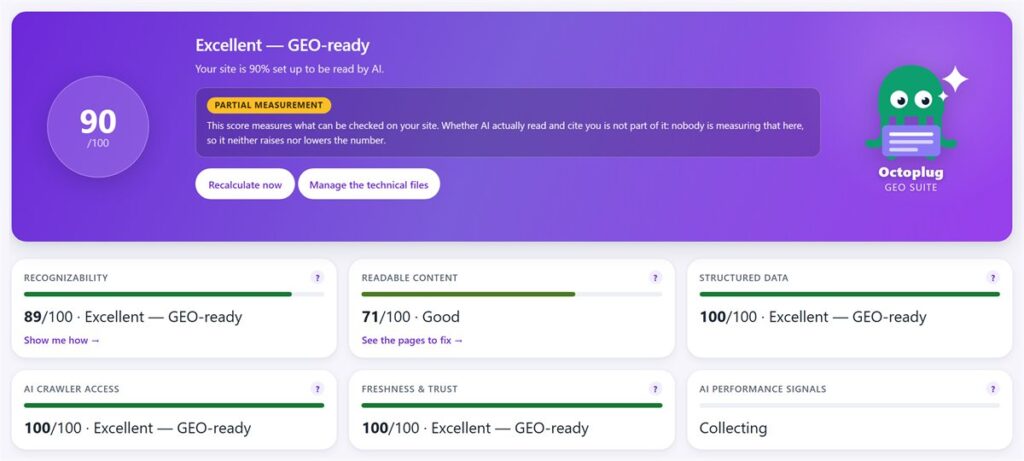
A dedicated plugin reads your published content and outputs valid, consistent JSON-LD automatically — the right type on the right template, dates that track your edits, an Organization block wired to your brand. With GEO Suite (free — direct download) the free plugin generates the foundational layer: your Organization (with sameAs), WebSite, Article — including a nested Person author node (job title, bio, sameAs to multiple profiles) — BreadcrumbList and FAQPage, served consistently and running alongside Yoast or RankMath. The GEO Score then shows how your structured data stacks up (Structured Data is one of its six weighted pillars) and flags what’s missing.
The honest split on tiers: the free version already generates the entity markup that resolves who you are for AI — Organization and a Person author, both with sameAs — plus the schema every content site should have. The paid Pro plan (from €99/year) layers on only two advanced pieces: speakable markup, and sameAs gap-fill — completing your entity links in the edge case where another SEO plugin, not GEO Suite, is the one emitting your schema.

GEO Suite (free — direct download) generates your foundational schema — Organization, WebSite, Article with a Person author node and sameAs, Breadcrumb and FAQPage — and scores the rest of your AI-readiness, alongside your existing SEO plugin.
How do you check your schema is actually working?
Paste your page URL into Google’s Rich Results Test or the Schema.org Validator: you should see your types detected — Organization, Article, FAQPage and so on — with no errors and no warnings that contradict your content. Then confirm the marked-up facts (author, dates, name) match what’s visible on the page. If a validator can’t parse it, neither can an AI.
- It parses cleanly — the validator detects your types with zero errors.
- It matches the page — every fact in the JSON-LD appears in the visible content.
- It’s consistent — the same schema logic applies across every template, not just the homepage.
- Nothing’s hidden — you’re not marking up FAQs or content users can’t see.
- It’s current —
dateModifiedand author details reflect the page as it is today.
You can run these by hand with the free validators, or use a readiness score that surfaces the gaps continuously, so you find a broken or missing block before an AI does.
Does schema guarantee an AI will cite you?
No. Schema makes your content easier for AI to understand, attribute and trust — it does not force a citation, and no tool can promise one. Generative engines weigh many signals: content quality, authority, freshness, entity reputation and their own opaque ranking. What structured data does is remove ambiguity, so when the other signals are in your favour, nothing technical is getting in the way. That’s the honest ceiling, and it’s still very much worth having.
Treat schema as table stakes, not a magic switch. The sites that actually get cited pair clean, consistent structured data with strong answer-first content, a resolvable entity identity, and the other GEO signals — llms.txt, crawler access, freshness. Schema is the layer that makes all of them legible to a machine. Skip it and you’re asking an AI to infer everything; add it and you’ve handed it the facts.
Schema is one signal — here’s the bigger picture
Structured data is one pillar of AI-readiness, not the whole building. Getting found and cited by AI depends on a stack working together: valid JSON-LD schema so machines understand what your content is, entity identity so they understand who you are, a clean llms.txt so crawlers know what to read first, answer-first content they can quote directly, and control over which AI bots reach your site. Perfect schema on a site that’s invisible to AI crawlers is a beautifully labelled box no one opens.
This is why GEO Suite is a suite rather than a schema plugin. The free version gives you the foundational schema (Organization, WebSite, Article with a Person author node and sameAs, Breadcrumb, FAQPage), an auto-generated .md version of every page, llms.txt and llms-full.txt, AI crawler control, and a six-pillar GEO Score with one-click fixes — Structured Data being one of those six. Generating a JSON-LD block is one line of the score. Seeing the whole picture, and knowing what to fix next, is the point.
Frequently asked questions
What is JSON-LD schema?
JSON-LD (JavaScript Object Notation for Linked Data) is the recommended format for adding structured data to a web page. It's a small block of labelled JSON, placed in the page's <head>, that describes your content — the organization, article, author, FAQs — in a way machines read but visitors never see. It's the cleanest way to write schema markup.
Does schema markup help with AI search?
Yes, indirectly. Schema doesn't guarantee an AI will cite you, but it makes your content easier for models to understand, attribute and trust — reducing the chance you're misread or skipped. Foundational types (Organization, Article, FAQPage) plus entity identity via sameAs are the ones that matter most for AI search.
Which schema types are most important for AI?
Organization and WebSite (who publishes the site), Article (what a page is and who wrote it), BreadcrumbList (structure), FAQPage (structured Q&A that maps to how people query AI), and Person with sameAs (proving author or brand identity across the web). The last one is the advanced entity layer most sites skip.
Do I need schema if I already use Yoast or RankMath?
Your SEO plugin already adds baseline schema (Organization, Article, Breadcrumb) for classic rich results, so you're not at zero. A GEO tool complements it with the AI-specific layer — entity identity, speakable, and an AI-readiness score — and is designed to run alongside your SEO plugin, not replace it.
Can I add schema without a plugin?
Yes — write the JSON-LD by hand and inject it into each page's <head>. The trade-off is maintenance and consistency: you update it manually as content changes, across every template, and drift is easy. A plugin generates valid, consistent schema from your existing content and keeps it current automatically.
Will schema get me cited by ChatGPT?
It improves your odds by making your content easier to parse, attribute and trust — but no one can guarantee a citation. AI engines weigh many signals. Pair clean schema with entity identity, answer-first content and the other GEO basics for the best chance.
Free plugin
See where your site stands with AI search — free
GEO Suite scores your site across the six GEO pillars, generates your llms.txt and JSON-LD schema, and shows you what to fix first.
Score your site across the six GEO pillars, generate your llms.txt and JSON-LD, and see what to fix first.
Download free →