
What Is GEO? Generative Engine Optimization Explained (2026)
GEO Academy · Module 1 — GEO Foundations · Updated August 2026 · by Octoplug
Generative Engine Optimization (GEO) is the practice of preparing your website so AI systems — ChatGPT, Perplexity, Gemini and Google’s AI Overviews — can find it, understand it, and cite it in their answers. It’s the AI-search counterpart to classic SEO: where SEO helps you rank in a list of links, GEO helps you get quoted when someone asks an AI a question instead of typing it into a search box.
On this page9 sections
If you’ve heard the terms GEO, AEO, AIO, “AI SEO” or “LLM SEO” thrown around and quietly wondered whether they mean the same thing — you’re not alone. The category is young, and the vocabulary hasn’t settled yet. This guide gives you the clear version: what GEO actually is, why it’s suddenly everywhere, how it differs from SEO (and from the tangle of related acronyms), and what a website needs to be “AI-ready.” No hype, no guarantees — just the working definition and where to start.
- GEO vs SEO: what changes when people ask instead of search — coming soon
- GEO vs AEO vs AIO vs LLM SEO: the terminology, decoded — coming soon
- Does GEO replace SEO? (No — here’s how they work together) — coming soon
- The 6 pillars of an AI-ready website — coming soon
What is Generative Engine Optimization (GEO)?
GEO is optimizing your content and your site’s technical signals so that generative AI engines can retrieve, interpret and reference it accurately. A generative engine — ChatGPT, Perplexity, Gemini, Google AI Overviews — doesn’t return ten blue links. It reads across many sources and composes an answer, sometimes citing the pages it drew from. GEO is the work of making sure your site is one of the sources it can read clearly and trust enough to cite.
The name was coined as AI answer engines went mainstream, and it deliberately echoes “SEO.” The parallel is useful: SEO emerged because a new kind of software (search engines) decided what people saw, and businesses needed to be legible to it. GEO exists for the same reason, one layer up — a new kind of software (large language models) now sits between people and information, and your site needs to be legible to it.
Crucially, GEO isn’t a single trick or a file you upload. It’s a set of overlapping signals — clear content, structured data, machine-readable summaries, crawler access, freshness — that together make your site easy for an AI to parse and hard for it to misunderstand. We’ll break those down further below.
Why does GEO matter now?
Because a growing share of the questions people used to type into Google are now being asked — in full sentences — to an AI. The behaviour has shifted, and it’s measurable: Google’s share of search has slipped from roughly 91% to about 78% since 2024, and AI platforms now handle an estimated 18–22% of the informational queries that once went to a search engine. When the answer comes from an AI, being ranked #3 on Google doesn’t help you if the AI never mentions you.
The numbers behind the shift are hard to ignore. ChatGPT reports on the order of 800 million monthly active users; Perplexity handles 230 million-plus searches a month and has grown explosively year over year. Surveys suggest a majority of adults in some markets now use AI assistants regularly, and a large share lean on them for product and service recommendations. That’s the moment the web is in: people don’t search anymore — increasingly, they ask. GEO is how your site earns a place in the answer.
There’s also a legitimacy signal worth noting. In May 2026, Google published an official AI Optimization Guide — the gatekeeper acknowledging, in writing, that optimizing for AI-generated answers is real, practical work, not speculation. When the biggest player in search formalizes a discipline, it has arrived. GEO is no longer a fringe idea; it’s an emerging layer of the craft.
GEO vs SEO: what’s the difference?
SEO optimizes to rank in a list of results; GEO optimizes to be cited in a generated answer. SEO’s target is the search engine results page — you want to be one of the ten links a human then chooses from. GEO’s target is the answer itself — you want the AI to read your content, understand it, and reference it when it composes a reply. Same underlying goal (be found), different reader, different finish line.
The practical differences follow from that:
| SEO (classic search) | GEO (AI search) | |
|---|---|---|
| Reader | Search-engine crawler | Large language model |
| Goal | Rank in a list of links | Be understood and cited in an answer |
| User behaviour | Types keywords, scans results | Asks a full question, reads one answer |
| Wins on | Keywords, backlinks, page authority | Clarity, structure, machine-readable signals, trust |
| Output you want | A high position | A citation / mention |
Notice what doesn’t change: quality content still wins. An AI, like a search engine, favours material that’s clear, accurate, well-organized and trustworthy. What GEO adds is a set of signals that make that quality legible to a machine that composes rather than lists — things like an llms.txt summary, JSON-LD schema, and answer-first writing the model can lift a clean quote from.
GEO vs AEO vs AIO vs LLM SEO: what do all these terms mean?
They mostly describe the same shift, from slightly different angles — and no single term has won yet. GEO (Generative Engine Optimization) is the broad, most-used label for optimizing for AI-generated answers. AEO (Answer Engine Optimization) emphasizes getting into the answer box. AIO and “AI SEO” are looser umbrella terms. “LLM SEO” names the same thing by its underlying technology. In everyday use they overlap heavily; the differences are emphasis, not opposing methods.
Here’s the honest decoder:
| Term | Full name | Emphasis | How it relates |
|---|---|---|---|
| GEO | Generative Engine Optimization | The whole practice of optimizing for AI-generated answers | The broadest, most common umbrella term |
| AEO | Answer Engine Optimization | Winning the direct answer / answer box specifically | A focused slice of GEO |
| AIO / AI SEO | AI (Search) Optimization | General “optimize for AI” framing | Loose synonyms, often marketing labels |
| LLM SEO / GAIO | LLM / Generative AI Optimization | Named after the technology doing the answering | Same goal, technology-first naming |
Why so many words for one idea? Because the category is only months old. The terminology is genuinely unsettled — you’ll see the same practitioner use two of these interchangeably in one article. Our take: treat GEO as the umbrella and AEO as the part of it that’s specifically about structuring content to win the answer. If someone tells you these are rival methodologies, be sceptical — under the hood, you’re doing the same work.
Does GEO replace SEO?
No. GEO complements SEO — it doesn’t replace it. Classic search isn’t going away; even at ~78% share, Google still drives the majority of web discovery, and AI engines themselves often pull from pages that rank well. The smart move isn’t to drop SEO for GEO. It’s to keep your SEO healthy and add the AI-search signals on top. They share a foundation — clear, high-quality content — and then branch into two readers you want to satisfy at once.
This matters for anyone worried about doing “yet another optimization job.” You’re not throwing away your Yoast, RankMath or AIOSEO work — GEO runs alongside it. Your SEO plugin handles titles, meta, sitemaps and the classic index; GEO tooling adds llms.txt, machine-readable page versions, richer schema and AI-crawler control. Same site, two complementary layers. If anything, the sites that get cited by AI tend to be the ones that already do the fundamentals well and then extend them.
How does GEO actually work? The 6 pillars of an AI-ready website
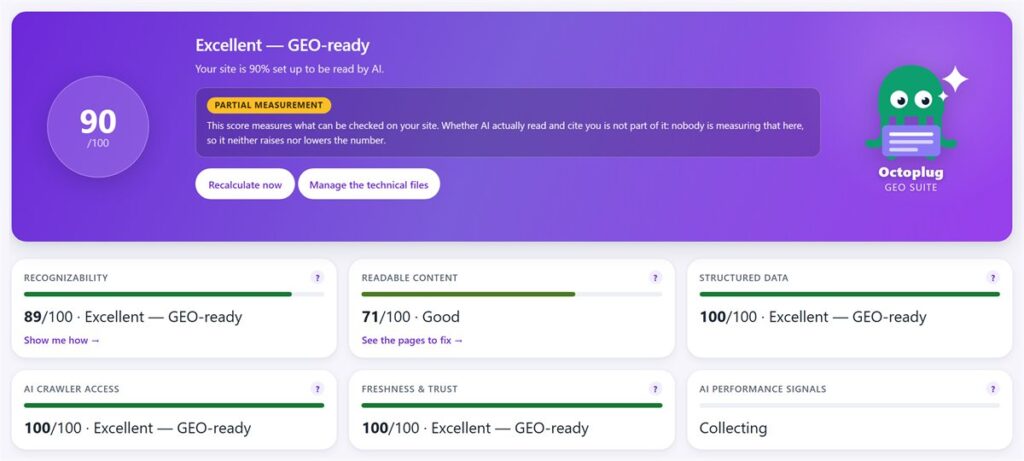
Getting cited by AI comes down to six areas working together — not one magic file. A generative engine has to be able to (1) tell who you are, (2) read your content, (3) understand what it means, (4) actually reach your pages, (5) trust that they’re current, and (6) see that AI systems are engaging with your site. Nail those, and you’ve removed the friction that keeps AI from finding, understanding and citing you. Here’s each one in plain terms:
- Recognizability — Can an AI tell who you are and what your site is about? This is your identity layer: a clear
llms.txtsummary, consistent branding, and entity signals that let a model place you confidently rather than guess. - Readable content — Is your writing structured so a machine can parse and quote it? Answer-first paragraphs, sensible headings, descriptive alt text — content built to be lifted cleanly into an answer.
- Structured data — Does your JSON-LD schema tell machines what your content means? Organization, Article, FAQ and breadcrumb markup turn a page of text into labelled, unambiguous facts.
- AI crawler access — Can the right AI bots actually reach your site? Crawlers like GPTBot, PerplexityBot and Google-Extended need permission (via
robots.txt) to read you at all. Block them by accident and nothing else matters. - Freshness & trust — Is your content current and credible? AI engines favour material that’s maintained and reliable over pages that look abandoned.
- AI performance signals — Are AI bots visiting, and is AI actually referring people to you? This is the measurable feedback loop — the proof that the other five are paying off. It’s the one pillar you can only see by tracking AI crawler visits and referrals over time.
You can work through these by hand — and you should understand them either way. But this is also exactly what a GEO tool is for: instead of auditing six areas manually, you get a single readiness score that shows where you stand and what to fix first.

GEO Suite (free — direct download) scores your site across all six pillars and shows you what to fix first — alongside your existing SEO plugin.
How do you start doing GEO?
Start by making your site legible to AI in three moves: publish an llms.txt, add proper schema, and write answer-first content — then check where you stand. None of these requires a rebuild. llms.txt is a plain-text summary that hands AI a clean map of your best content. Schema (JSON-LD) labels what your pages mean. Answer-first writing puts a quotable, direct answer at the top of each page. Together they cover most of the six pillars above without touching your design.
On WordPress specifically, the fastest path is a plugin that handles the technical pieces for you — generating llms.txt, outputting schema, exposing machine-readable versions of your pages, and managing which AI crawlers can read your site — then scoring the whole thing so you know what’s actually missing. That’s the difference between reading about GEO and doing it: you want a number that tells you where you stand today, and a short list of fixes ranked by impact.
A sensible first week looks like this: publish and validate an llms.txt, make sure you’re not accidentally blocking AI crawlers, add Organization and Article schema, and rewrite your two or three most important pages answer-first. Then measure — because GEO, like SEO, is a loop of check, fix, and check again. Grab the free GEO Readiness Checklist to run this on your own site.
Can GEO guarantee I’ll be cited by ChatGPT?
No — and treat anyone who promises otherwise with real caution. No method, plugin or platform can guarantee that an AI will cite your site. Generative engines weigh many signals — content quality, authority, structure, freshness, and their own opaque, changing ranking logic — and they don’t publish the recipe. What good GEO does is remove friction and improve your odds: it makes your site easier for a model to find, parse, trust and quote correctly. That’s the honest ceiling, and it’s still very much worth reaching for.
Adoption is also uneven and moving. Not every AI engine reads llms.txt yet; schema support varies; the terminology itself is still settling. So the right mindset is pragmatic: treat GEO as a set of low-cost, forward-looking signals that compound as AI search grows — not a switch you flip for instant citations. Do the six pillars well, measure, and keep your content current. The sites that win AI citations are the ones that made themselves the clearest, most trustworthy source available when the model went looking.
Frequently asked questions
What does GEO stand for?
In this context, GEO stands for Generative Engine Optimization — preparing your website so AI systems like ChatGPT, Perplexity and Gemini can find, understand and cite it. (It's occasionally used for geolocation elsewhere; that's a different, unrelated meaning.)
Is GEO the same as SEO?
No. SEO optimizes to rank in a list of search results; GEO optimizes to be understood and cited in an AI-generated answer. They share the same foundation — clear, high-quality content — but target different readers. Most sites should do both.
Is GEO the same as AEO?
They're closely related and often used interchangeably. GEO (Generative Engine Optimization) is the broad umbrella; AEO (Answer Engine Optimization) is the part focused specifically on structuring content to win the direct answer. In practice you do largely the same work under either name.
Do I need GEO if I already do SEO?
Increasingly, yes. SEO gets you ranked; GEO helps you appear when people ask an AI instead of searching. GEO runs alongside your existing SEO plugin (Yoast, RankMath, AIOSEO) rather than replacing it — it's an additional layer, not a swap.
Is GEO an official standard?
No. GEO is an emerging discipline, and its core conventions — like llms.txt — are proposals and community conventions, not official web standards. That's normal for a field this young. It's worth adopting as support spreads across AI engines, not treating as a settled rulebook.
Can a plugin guarantee AI will cite my site?
No honest tool will promise that. AI engines weigh many signals and don't disclose their ranking. A good GEO tool prepares your site to be found and cited — and measures whether it's working — but a citation itself can never be guaranteed.
Free plugin
See where your site stands with AI search — free
GEO Suite scores your site across the six GEO pillars, generates your llms.txt and JSON-LD schema, and shows you what to fix first.
Score your site across the six GEO pillars, generate your llms.txt and JSON-LD, and see what to fix first.
Download free →