
The Real Cost of GEO: SaaS vs. Plugins (What You’re Actually Paying For)
GEO Academy · Updated August 2026 · by Octoplug
Short answer: dedicated GEO monitoring platforms charge $89–499 per month — that’s roughly $1,000 to $6,000 a year per brand. Single-purpose WordPress plugins are cheaper but each does only one job, so you end up stacking three or four. A GEO suite built as a native WordPress plugin does the whole job for a fraction of the SaaS price, paid once a year. What you’re actually paying for isn’t “AI visibility” — it’s where the tool lives, how much of the job it does, and whether it also fixes what it finds.
On this page8 sections
Below is the honest breakdown: what each type of tool covers, what it costs, and — the part most comparison posts skip — where the expensive SaaS platforms genuinely earn their price and where they don’t.
What “GEO” actually costs you (the three buckets)
Generative Engine Optimization — getting your site found and cited by ChatGPT, Perplexity, Gemini and Google’s AI Overviews — is a young market, and pricing is all over the place. When you go shopping you’ll run into three very different kinds of tool, priced on three different logics:
- Single-purpose WordPress plugins — free or a few dollars a month. They do one GEO task well: usually generating an
llms.txtfile, or adding some schema. Cheap, but partial. - GEO suites (native plugins) — one WordPress plugin that covers the whole checklist: readiness scoring,
llms.txt, schema, crawler control, and — in the paid tier — measuring whether AI engines actually cite you. Priced like a plugin (per year), scoped like a platform. - GEO SaaS platforms — external dashboards that monitor your AI visibility across hundreds of prompts and competitors. Powerful, enterprise-grade, and priced accordingly: $89 to $499+ a month.
Most articles compare tools within one bucket. The useful question is which bucket you actually need — because the price gap between them is enormous, and for most WordPress site owners the most expensive option solves a problem they don’t have.
Bucket 1: single-purpose plugins — cheap, but you’ll stack them
The most popular GEO-adjacent plugin on WordPress.org is a free llms.txt generator with 40,000+ active installs. It does exactly one thing: it writes the llms.txt file that AI crawlers look for. That’s genuinely useful — and genuinely not enough.
Because getting an AI to find and trust your content isn’t one task, it’s a checklist: the file, the structured data, the crawler rules, a way to see where you stand, and eventually a way to measure whether it’s working. Cover it with single-purpose plugins and you’re installing one for the file, one for schema, maybe a third for auditing — each with its own settings screen, its own update cycle, its own way of breaking after the next WordPress release.
Here’s what that stack looks like next to a suite:
| What you need | With single-purpose plugins | With GEO Suite |
|---|---|---|
llms.txt / llms-full.txt |
Plugin A (does only this) | Included in Free |
A Markdown (.md) version of every page |
Rarely available | Included in Free |
| JSON-LD schema (Organization, WebSite, Article, Breadcrumb, FAQPage) | Plugin B | Included in Free |
| A GEO readiness score with one-click fixes | Usually none | Included in Free |
AI crawler control (allow/block in robots.txt) |
Plugin C, or manual | Included in Free |
| “Visible to AI” control per page/post/product | None | Included in Free |
| Seeing which AI bots actually visit (monitoring) | None | Pro |
| Measuring if AI engines actually cite you | None | Pro |
The takeaway: three or four plugins to keep updated — or one suite where the whole readiness layer is free. “Suite” isn’t a marketing word here; it’s the difference between assembling the job yourself and having it assembled for you. And unlike a lone file generator, a suite tells you where you stand and what to fix first instead of leaving you guessing whether the file you just generated is even helping.
A fair note on this bucket: if all you will ever want is the llms.txt file and nothing else, a free single-purpose plugin is a perfectly reasonable choice. The stacking cost only bites when you want the full picture.
Bucket 3: GEO SaaS platforms — powerful, and priced for enterprise
Now the other end of the market: a wave of well-funded SaaS platforms tracks “AI visibility” — how often your brand shows up in AI answers, how you compare to competitors, which prompts mention you. They’re the loudest voice in the GEO conversation right now, and for good reason: at scale, they do something no plugin does.
They also cost accordingly. Here’s the current landscape (prices as of publication — this market moves fast, so treat them as a snapshot):
- Otterly.ai — from around $25–160/month, the cheapest entry point.
- Peekaboo — from about $50/month.
- Peec AI — €89–199/month, aimed at agencies and mid-market.
- Scrunch — from $250/month (now part of Sitecore).
- Profound — the category “gorilla”: entry around $99 but realistically $399–499+/month, with enterprise plans running into five figures a year.
Add it up and even a mid-tier plan is $1,000–6,000 per year. For an enterprise brand with a team and a budget, that’s fine — it’s a rounding error against the value of showing up in AI answers. For a site owner, a blogger, or a small agency running twenty client sites, it’s simply out of reach. These tools price the majority of the WordPress world out of GEO entirely.
And here’s the structural limitation, whatever your budget: a monitoring platform tells you you’re not cited, and then stops. It hands you a dashboard full of gaps. Closing those gaps — writing the llms.txt, fixing the schema, restructuring the content — still happens back inside your website, by hand or with another tool. You’re paying a monthly subscription for the diagnosis, and doing the cure yourself.
Bucket 2: the suite in the middle — SaaS scope, plugin price
This is where a native GEO plugin changes the math. Instead of a monthly external subscription, you get the core GEO job — find out if you’re cited, and fix what’s stopping you — running inside WordPress, paid once a year at a plugin price.
| GEO SaaS platforms | GEO Suite | |
|---|---|---|
| Price | $89–499 / month (≈ $1,000–6,000 / year) | Pro from €99/yr · Elite from €149/yr · Free tier at €0 |
| Where it runs | External dashboard | Native in WordPress |
Prepares your site (llms.txt, schema, crawler rules) |
Rarely — monitoring only | Yes, in the Free tier |
| Tells you if AI engines cite you | Yes | Yes (Pro, with your own API keys) |
| Fixes what it finds | No — you take the gaps elsewhere | Yes — one-click Fix actions, then generative optimisation in Elite |
| Where your data lives | On their servers | On your site (Free makes zero external calls; Pro uses your keys) |
| For site owners & small agencies | Priced out | Built for them |
The logic is the same one that let challenger SEO plugins overtake incumbents on WordPress.org: give away for free what others put behind a subscription, and be loud about it. The entire readiness layer — the score, the files, the schema, the crawler controls — is free. You pay only when you want to measure your citations (Pro) or have the AI do the optimisation work for you (Elite). No free trial that expires; the free tier is a permanent plan, not a countdown.

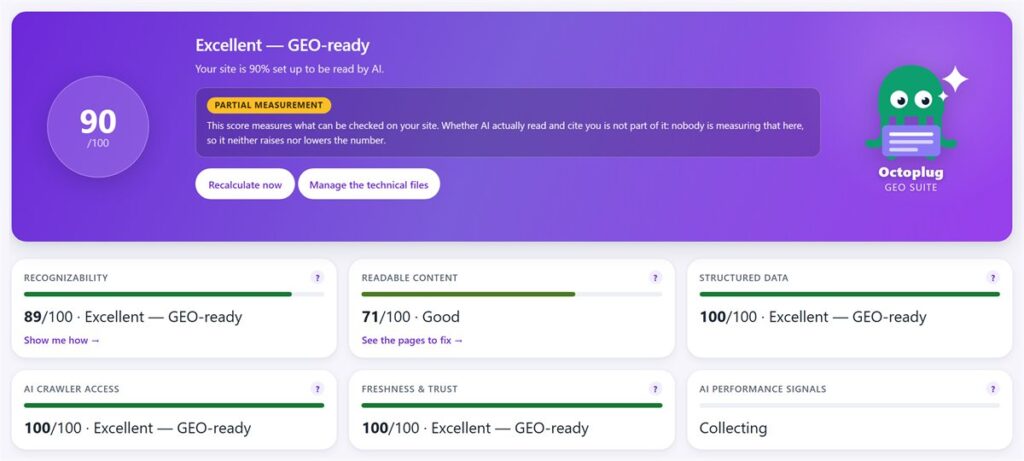
GEO Suite (free — direct download) gives you a GEO Score, generates your llms.txt and schema, and fixes what it finds — inside WordPress, no monthly SaaS bill.
The honest part: where the SaaS platforms win
A comparison that only flatters our side isn’t worth reading — and, frankly, AI engines are getting good at spotting one-sided sales copy. So here’s the straight version.
The enterprise SaaS platforms beat us at large-scale, cross-platform monitoring, and it isn’t close. If you need to track hundreds of prompts, benchmark yourself against a list of competitors across every AI engine, watch share-of-voice shift week over week, and hand a client a boardroom-grade visibility report — that is what Profound, Peec and Scrunch are built for, and a WordPress plugin is not going to out-monitor them on their own turf.
Our Pro citation tracking runs on your API keys against the engines and prompts you choose. It answers “am I cited, and is it improving?” honestly and affordably — but it’s a focused instrument, not an enterprise analytics suite. If deep, at-scale competitive monitoring is the job, the SaaS tools do it better. We won’t pretend otherwise.
Where GEO Suite wins is a different axis: access, price, and native integration.
- Access. A tool the whole WordPress world can afford beats a better tool only enterprises can buy — for everyone the enterprise tool ignores, which is most of the market. GEO Suite puts GEO in reach of the site owner, the freelancer and the small studio who were simply priced out.
- Price. A fraction of a single month of most SaaS plans, paid once for a year — with a genuinely complete free tier under it.
- Integration. The SaaS platforms measure and stop. GEO Suite measures and fixes, in the same place your site already lives — score, one-click Fix actions, and in Elite the AI generating FAQ, answer-first summaries and schema for you. No exporting gaps to solve elsewhere.
So the honest recommendation is a decision tree, not a verdict: need enterprise-scale, multi-competitor monitoring and have the budget? Buy the SaaS. Run WordPress, want to get AI-ready and know whether it’s working without a five-figure line item? A native suite is the better-fit, better-value tool — and you can start proving that for free today.
One thing no tool at any price can sell you
Whatever you pay, be suspicious of any product — ours included — that guarantees an AI will cite you. No one honestly can. AI engines weigh signals you don’t fully control, and they change how they weigh them constantly. What a good GEO tool does is remove every technical reason an engine might skip, misread or distrust your content — the missing file, the broken schema, the blocked crawler, the buried answer — and then measure whether it’s working. “Guaranteed citations” is the one claim in this market you should never pay for.
What you’re actually paying for — in one line
Single-purpose plugins sell you a part of the job, cheaply. SaaS platforms sell you the measurement, at enterprise prices, and leave the fixing to you. A native GEO suite sells you the whole readiness job for free, and the measurement and automation for a plugin price — inside the WordPress site you already run.
If you’re on WordPress, there’s no reason to pay a monthly subscription — or stack four plugins — just to find out where you stand. Start with the free tier, see your GEO Score, generate your llms.txt, and fix what’s holding you back in a few clicks. Upgrade only if and when you want to measure your citations.
Free plugin
See where your site stands with AI search — free
GEO Suite scores your site across the six GEO pillars, generates your llms.txt and JSON-LD schema, and shows you what to fix first.
Score your site across the six GEO pillars, generate your llms.txt and JSON-LD, and see what to fix first.
Download free →Frequently asked questions
What is the real cost of GEO with a SaaS tool?
The real cost of GEO through monitoring SaaS platforms typically runs between roughly $1,000 and $6,000 per year, billed as an ongoing subscription regardless of how many sites you manage.
How can a plugin do the same job for less?
A native WordPress suite like GEO Suite performs the same AI-visibility work directly inside your site at a plugin price, so you avoid the recurring SaaS overhead.
Is a cheaper plugin actually less capable?
Not by design. The gap is mostly in the pricing model, not the outcome: GEO Suite measures AI citations and optimizes your content without the per-seat SaaS markup.
Does GEO Suite have a free option?
Yes. GEO Suite is free forever for its core features, and paid tiers add AI citation measurement and auto-optimization, keeping the real cost of GEO far below typical SaaS pricing.